Marketing and Communications
30+ Eco-Friendly and Zero-Waste Gift Ideas for the Holidays 2023
Spread holiday cheer and positive impact with our sustainable gift-giving guide.
BlogMarketing and Communications
During our recent sustainability event circuit, Sparx had the chance to ask the community an extremely important question: “What is one change you think needs to be made to improve awareness of the circular economy?” Read on to find out what the respondents had to say, and gain insights and ideas for your own work in the circular economy space.
This fall, Sparx travelled to several circular economy and sustainability events, including the 2026 Canadian EPR Forum, the CWMA’s Annual Conference, the 2026 RCA Circular Economy Conference, and the RCC’s Retail Sustainability Conference. While we were having an amazing time learning, connecting, and sharing insights, we also seized the opportunity to peer into the community’s thoughts on a topic that is very relevant, not just to Sparx, but the circular movement as a whole: awareness.
“What is one change you think needs to be made to improve awareness of the circular economy?”
We created a board where anyone who walked by could write on a sticky note and share their answers to this question.
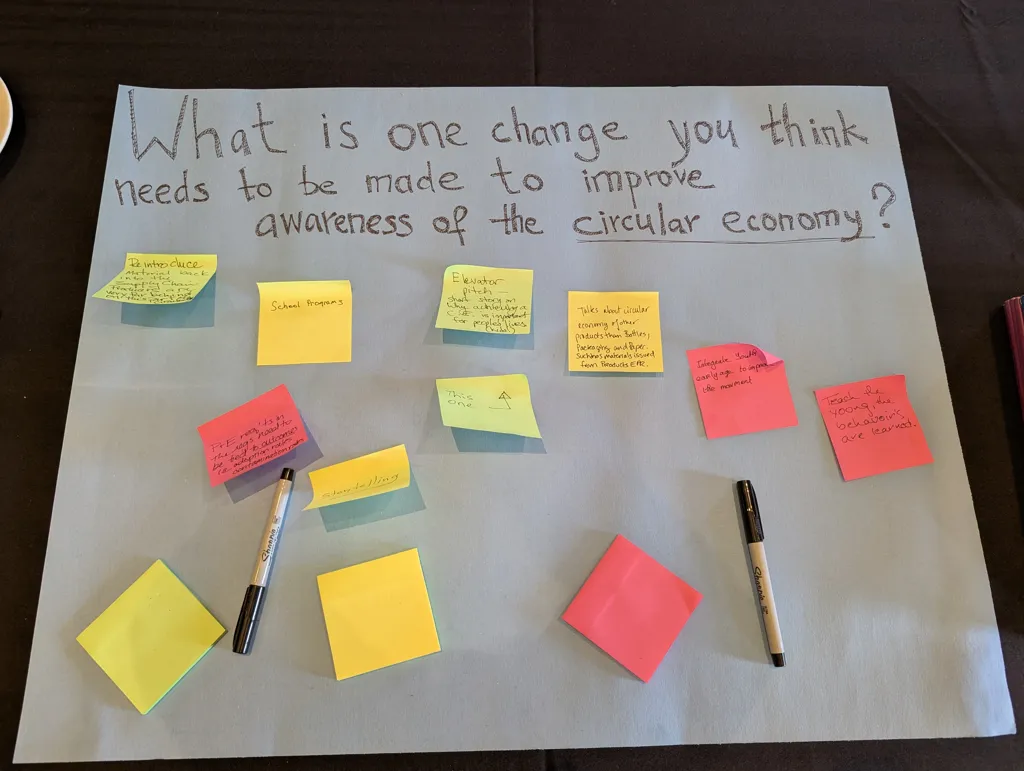
Upon returning home from our tour, we began reviewing the brightly coloured responses. While some answers confirmed our suspicions, others raised unique points.
Now, we want to share what the community shared with us.
Read on to see different perspectives from the circular economy community and glean takeaways that may just prove helpful for your organization, advocacy work, or solution.
Several of the sticky notes orbited around a specific demographic, calling for circular economy education within “school programs” aimed at children across Canada.
“Integrate youth at [an] early age to improve the movement,” said one sticky note. Another said, “encourage and educate the youth.”
As the responses highlighted, “teach the young, the behaviours are learned.” If, “in schools, grade one and up, [we] teach kids about (1) reduce (2) reuse (3) repair (4) recycle[,] once they know this[,] the parents will be influenced.”
Sparx believes in the importance of educating tomorrow’s circular economy leaders. That’s why Circular Economy Magazine has a 10+2 bundle for placing issues in post-secondary institutions. But the community has called all of us to start educating people about circularity much earlier.
If you build a strong foundation, not only will children be mindful about their relationship with consumption, waste, and conservation from their youth, but they will develop lifelong habits that could help create a better tomorrow and prevent further harm. Making circularity a part of everyday habits is an excellent way to drive positive change, take steps toward making it the default system, and help future generations achieve better outcomes.
Using storytelling to advance awareness, adoption, and ultimately drive positive change is what Sparx does every day as marketing and communications specialists. But what does the circular economy community think?
Several answers aligned with our mission. One sticky note provided a single-word answer to our question about awareness: “storytelling.”
Some of the responses expanded on this idea, with one note saying, “elevator pitch—short story on why achieving the circular economy is important for people's lives (kids!).” And we couldn’t agree with that idea more.
As someone else pointed out, it’s important that we not only take storytelling to the next level, crafting narratives that inspire hope, action, and help others see the value of circularity, but also to tell the story in a way that’s accessible. “Using common language” was an important note. Another person even pitched the idea that we “need a public-friendly name instead of ‘circular economy’.”
As Danielle Holly, Executive Lead, North America of the Ellen MacArthur Foundation said in a special content piece for Circular Economy Magazine: Issue 02, “The place to start is to talk about the circular economy in a way that’s tangible for both your context and the reality of those you’re trying to bring along. You don’t need to use the term ‘circular economy’ to talk about the circular economy. You can talk about the joy you get when you find a fabulous thrift store find, and share the brands and circular business models that made that find possible. You can talk about companies [...] making it possible for you to turn your old electronics into something other than e-waste.”
Attention is the start of awareness, and the community had some ideas on how to raise awareness by making circular economy messaging memorable, exciting, and attention-grabbing.
There was a sticky note that said, “more memes (e.g. City of Calgary EPR social media).” Memes are indeed memorable and very popular today, especially online.
While “meme” is the name we have given viral content—often relatable and with an easily replicable template—the term “meme” comes from the Greek “mimema,” meaning “imitated.” The “meme” has been regarded as a unit of cultural information spread by imitation ever since the cultural concept was introduced in 1976 by British evolutionary biologist Richard Dawkins.
Laughter and cleverness are great ways to attract people’s attention and make a lasting impression. Relatability could also prove instrumental in transforming circularity into action.
Looking at City of Calgary posts like this one about newly accepted items for recycling, this "most important events in history" post, this one about what should not go into blue bins, and this clever post about sorting in the holiday, we definitely feel inspired and amused. A strong impression is powerful. And if we can invent some fresh, fun memes that originate from circular economy changemakers, organizations, and advocates, we might just be able to get a lot of people to engage and pass it along.
Other highly visual mediums and platforms were also suggested, including “TV commercials.” These would help present information in an engaging and informative way both online, in the form of ads, and outside of the internet, which could reach different audience segments.
Seeing circularity in action is another valuable way we can cross the awareness gap. A sticky note on our board held this suggestion: “visualize products made from recyclables.” By showing concrete, tangible examples of existing products created through circularity, we can help people see it as a viable option relevant to their everyday lives. It gives them a point of interaction and creates a personal connection.
Another response said, “Show the ROI. Food → compost → food.” Narrative methods such as the example provided would help ground circular economy outcomes in reality. Food is particularly poignant, as it's essential to everyone on the planet and all of our living systems. Realizing food can be given a second life as more food, turning waste into compost (possibility and value) could help not only raise awareness but spark action and change.
Going beyond such examples, we can show another kind of ROI (return on investment), one that can help spread awareness beyond consumers. If we find ways to concretely prove the ROI of circularity to organizations, boards, producers, manufacturers, and retailers—that circular economy solutions and strategies are good for the planet and for their bottom line—we can help raise awareness and drive change in the business world.
With the right messaging, we can also prove that “one person's waste could be another person's opportunity.”
Other respondents also said that they felt awareness can be raised through “in-person circular/sharing economy community events” and by giving “talks about circular economy of other products than bottles, packaging, and paper, such as materials issued from products EPR.”
We wholeheartedly agree. We’ve been sponsoring and attending events for the purpose of raising awareness, building connections, and helping others find ways to cross circular economy-related communications gaps. Responses like that just prove the value of organizing and attending events. They can serve as a platform for reaching and uniting so many individuals across sectors, industries, and geographies, providing chances to share solutions, insights, and learnings.
Furthermore, it’s important that we go beyond the current level of circular economy awareness and strive to continually increase knowledge and understanding. While some types of circular products and materials tend to take the spotlight, others remain in the shadows. We need to make sure people are aware of these products and materials as well, putting the full potential and possibilities of circularity into focus.
Full awareness is crucial. We should give special attention to areas, materials, and aspects that tend to be neglected, overlooked, and misunderstood—especially if people don’t realize they even fall within the scope of the circular economy!
Ready to tell your circular economy story and cross the awareness gap? Sparx specializes in making sure your communications reach the right audience at the right time. Together, we can help advance your solutions, innovations, and ideas, and make circularity a household word.
Contact us today. Let’s make the closed loop system the default.